


NotesGuides
Mat Storage and Travel
How to roll it, where to keep it, how to get it through an airport, and what a week folded in a suitcase does to a mat.
Contents
How to roll it, where to keep it, how to move it, and what a week folded in a suitcase does.
Rolling
Roll, do not fold. Folds become permanent creases in any material — a hard line in rubber and PVC, a stress line in cotton canvas. A creased mat never lies quite flat again and the crease is where cracking starts.
Roll with your practice surface facing out. The outer face of a roll is under slight tension and the inner is compressed, so the outer surface lies flatter when you unroll it. Practice side out means the side you kneel on is the flatter one.
There is a competing argument for rolling practice-side-in to keep the surface clean. If you store the mat in a bag, that is reasonable. If it stands in a corner, roll it surface out.
Roll it evenly and not too tight. A tight roll stresses the material and takes longer to lie flat. Snug is enough.
Never roll it damp. The single most common cause of a mat that smells. Lay it flat or hang it for twenty minutes after practice, always.
Storing at home
Standing on end, in a corner or against a wall. Best position. No weight on it, no crease, dries fully, and it is visible — which matters more than it sounds, because a mat you can see gets used.
Flat under a bed or a sofa. Also fine, and better than rolled for a mat you use rarely.
Not: in direct sunlight. UV destroys rubber and fades everything. A mat standing in a sunny window will be visibly degraded within a year.
Not: in a garage, shed, loft or car boot. Temperature swings are hard on rubber, and damp is hard on everything.
Not: with something heavy on top. A rolled mat under a stack of boxes deforms permanently.
Not: in a closed bag long-term. Anything even slightly damp will mildew.
Carrying
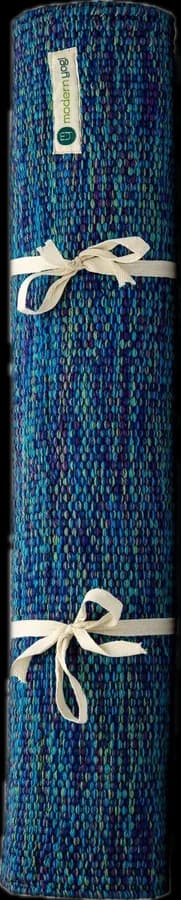
A sling or strap is the minimum: two loops of webbing around the rolled mat. Cheap, light, nothing to go wrong.
A bag adds protection from rain and from whatever else is in the boot of your car, and usually a pocket. The trade is that a mat put wet into a bag will be worse when it comes out.
What to look for: a bag long enough — measure your mat, not the average; an opening that runs most of the length, since end-loading a bag is tedious; a shoulder strap; and breathable material. Cotton canvas breathes; coated nylon does not, which is fine for a wet walk home and bad for storage.
On a bicycle: across the back, not over one shoulder, or it will swing into the wheel.
Air travel
A standard rolled mat is not carry-on friendly. It exceeds most airlines' personal-item dimensions, and while it is often allowed in practice, it depends entirely on the airline and the gate.
Realistic options:
A thin mat, folded, in a case. A 3 mm mat folds into a suitcase and takes little space. Cotton and thin TPE fold without permanent damage. A thicker rubber mat does not fold well.
A travel mat. 1–2 mm, designed to fold, no padding. Adequate as a grip layer over a hotel carpet, unpleasant on a hard floor.
No mat. For a short trip, practise on a carpet, a towel, or a hotel mat. A week without your own mat is not a problem.
Rolled and checked inside a case, if it fits diagonally.
What folding does
Cotton: creases, and they come out with use and washing within a week. No lasting harm.
Thin TPE: creases, mostly recoverable.
Rubber: do not fold. Rubber creases permanently and cracks along the fold line within months.
PVC: creases hard, and the crease stays.
Cork: do not fold. Cork cracks at a fold and the surface flakes away along the line.
So: cotton and thin TPE travel folded; rubber, cork and PVC do not.
Reviving a folded mat
Unroll it and leave it flat, ideally under something evenly heavy — a rug, a mattress, a few books distributed along the crease. Twenty-four hours.
For cotton, a wash and a flat dry removes creases entirely.
Warmth helps: a warm room, not a radiator. Direct heat is worse than the crease.
Two mats
Worth considering if you travel often or practise in two places.
One good mat at home, thick enough and heavy enough to be right, never moved.
One thin mat that lives in a bag for studio, travel, and the office.
The second one also works as a topper over a studio mat, which solves both hygiene and wet grip in a single object. This is a more useful arrangement than one compromise mat carried everywhere, and often no more expensive.
Hotel and studio mats
Assume nothing about them. Shared mats are cleaned inconsistently.
Bring a thin cotton mat or a towel to lay over the top. It solves the hygiene question and, because it is absorbent, usually improves the grip as well.
If you have nothing: a bath towel works for floor work. It slides on hard floors, so keep the standing sequence short.