


NotesGuides
Types of Yoga Mat, and Who Each One Is For
PVC, TPE, rubber, cork, jute, cotton — what each material is genuinely good at, what it fails at, and the practice that suits it.
Six materials cover essentially the whole market. Each one is genuinely good at something and genuinely bad at something else, and none of them is the best mat. Here is what each is, how it behaves, and who should buy it.
PVC
Polyvinyl chloride. The original sticky mat, and still the most common thing sold.
Behaves like: high dry grip, closed-cell so nothing soaks in, very durable — a good PVC mat lasts a decade of regular use. Cheap versions are a different product entirely: soft foam that compresses permanently and starts flaking within a year.
Fails at: wet grip, badly. Sweat sits on the surface and the mat becomes slick. It is also plastic, it does not biodegrade in any meaningful timeframe, and the cheap end of the category is the single largest source of thrown-away yoga equipment.
Buy if: you practise in a cool room, you want maximum dry grip, and durability per pound matters most.
TPE
Thermoplastic elastomer. Sold as the environmental answer to PVC, which is only partly true — it is recyclable in principle and rarely recycled in practice.
Behaves like: light, soft, a bit spongy underfoot. Usually cheaper than rubber.
Fails at: longevity. TPE compresses. A mat that felt supportive in month one is noticeably flatter in month eighteen, and the surface tends to polish smooth in the high-traffic spots — exactly where the hands go.
Buy if: you want light and inexpensive and you accept replacing it every couple of years. Otherwise skip it.
Natural rubber
Tapped from the rubber tree, so genuinely renewable, and the grippiest dry surface available.
Behaves like: heavy — a full-size rubber mat is 2.5 to 3.5 kg — and dense, with excellent floor anchoring. Superb dry grip.
Fails at: wet grip, same as PVC, and it degrades in ultraviolet light. Leave a rubber mat in the sun and it goes chalky, then brittle, then it cracks. It also has a strong smell for the first weeks, and it is a latex product, which rules it out for anyone with that allergy.
Buy if: you practise on hard floors in a cool room, and you are not going to sweat much. Best-in-class at what it does.
Cork
Usually a cork surface bonded to a rubber base.
Behaves like: hard, smooth, and slightly more grippy as it gets damp — the one closed-surface material that improves when wet, because of the waxy substance in cork's cell walls. Naturally antimicrobial. Handsome.
Fails at: cushioning. A cork mat is a firm floor with a texture on it, and kneeling on one is unpleasant. The cork surface also sheds fine dust over the first months, and the bond between cork and rubber is the usual failure point.
Buy if: you sweat, you practise standing shapes, and you have good knees. Terrible first mat, excellent second one.
Jute
Plant fibre, usually woven and bonded to a rubber or PVC base.
Behaves like: rough, textured, mechanically grippy, extremely durable.
Fails at: comfort. Jute is coarse enough that long holds on bare skin are genuinely unpleasant, and the fibres shed. Most people who buy one use it for a season and go back.
Buy if: you want maximum texture and you do not spend time lying on the mat.
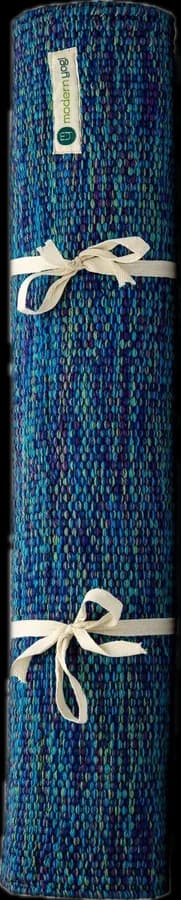
Cotton
Woven cloth, either cotton on both sides or a cotton surface over a rubber base.
Behaves like: grips mechanically when dry — a weave is thousands of small raised edges — and holds grip when wet, because the moisture goes into the fibre rather than sitting between you and the mat. The only surface here that can be machine-washed. Softens with use rather than degrading.
Fails at: raw dry grip against rubber. Cold, dry, in the first minutes of a practice, a rubber mat has more immediate bite. A cotton-on-both-sides mat will also travel on a polished floor unless it has a rubber base.
Buy if: you sweat, you want to be able to wash the thing you put your face on, or you want one mat that also works as a topper and a travel layer.
Choosing between them
Strip it back to two questions.
Will you sweat? If yes, the honest shortlist is cotton or cork. Everything else needs a towel over it, and a towel over a mat is an admission that the mat is not doing its job.
Do you need padding? If yes, cork and jute are out. That leaves cotton at a thicker gauge, rubber, or good PVC.
Two questions, and the field usually narrows to one answer.
A note on what does not matter
Antimicrobial claims: any mat you can wash beats any mat with a treatment on it. Alignment markings: set for a body that is not yours. Reversible dual-colour surfaces: a colour, not a feature. Thickness stated to a tenth of a millimetre: within the same category, nobody can feel the difference.