


NotesCraft
The Weave of a Mat
Warp, weft, thread count, and why a handwoven surface behaves differently underfoot than a milled one.
Contents
Warp, weft, thread count, and why a woven surface behaves differently underfoot than a milled one.
The vocabulary
Warp — the threads that run the length of the fabric, held under tension on the loom. They are stronger and more tightly twisted, because they take the strain of the weaving process.
Weft — the threads that cross the warp, passing over and under. Less tension, often a softer yarn.
Weave structure — how the two interlace. Plain weave is one over, one under. Twill goes over two and under one, offset each row, producing a diagonal line and a denser, more drapable cloth. Canvas is a plain weave with heavy yarn and a high thread count.
Selvedge — the finished edge where the weft turns back. It does not fray, which is why it is the strongest part of a woven cloth.
Why a weave grips
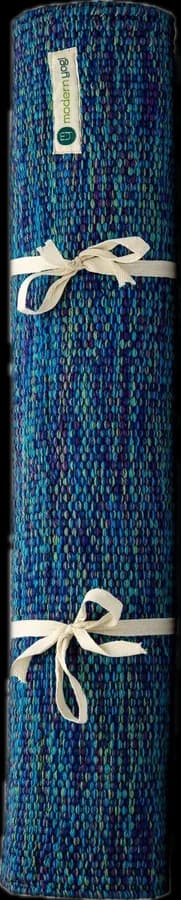
The surface of a woven cloth is not flat. It is a regular field of raised intersections — thousands of small edges per square metre, each one a place where skin or cloth can catch.
This is mechanical grip: friction from surface texture, not adhesion from tack. It is a completely different mechanism from a rubber or PVC mat, which grips by deforming around the ridges of your skin.
Two consequences follow.
A weave grips wet. The intersections do not disappear when the surface is damp, and the yarn absorbs the moisture into itself, taking it off the interface. A sealed surface has nothing to absorb into, so the water sits on top and acts as a bearing.
A weave grips more as it opens. Which is the opposite of what happens to a rubber mat.
What happens to a weave with use
A new woven mat is at its tightest. The yarn is under tension from the loom, the weave is compressed, and any finishing treatment is still present. The surface is comparatively smooth and stiff.
Over the first weeks: the weave relaxes as the yarn releases the tension it was held under. The mat softens and lies flatter.
Over months: individual fibres lift slightly from the surface of the yarn — the beginning of the fine surface nap that any used cotton develops. That nap adds texture, and texture is grip.
With washing: any residual finish comes off, absorbency increases, and the softening accelerates.
The direction of travel is towards a better surface, for years, which is not true of a single other mat material.
Handwoven versus power-loomed
Both produce cloth. The differences are real and are mostly about consistency.
A power loom produces a very even fabric. Every intersection is identical, the tension is uniform, and the surface is regular.
A handloom produces slight variations — in beat, in tension, in yarn thickness. The result is a fabric with small irregularities across its surface.
Underfoot, the irregular one has marginally more texture, because the variation itself is texture. Whether that is perceptible in practice is a genuine question and the honest answer is: slightly, to some people, some of the time.
What is more clearly true: a handloom permits heavier yarns and looser, more open constructions that industrial looms handle poorly, and those constructions absorb more and grip more.
Thread count, and why it is not the number to look at
Thread count — threads per inch — is a bedding metric and it transfers badly.
Higher is not better here. A very high thread count with fine yarn produces a smooth, dense, sheet-like fabric, which is the opposite of what a mat surface wants. Sheets want smooth; a mat wants texture and absorbency.
The useful numbers are:
Weight, in grams per square metre. This tells you how much material is actually there. A heavier fabric has more yarn, more absorbency and more durability.
Yarn thickness. Heavier yarn, coarser texture, more grip, more absorption.
Weave openness. How much air is in the structure. An open weave absorbs and dries faster; a very tight one behaves more like a sealed surface.
How a weave fails
Abrasion at the wear points. The high-traffic patches — where hands and feet go — thin gradually as fibres wear away. This is slow, visible, and it takes years.
Edge fraying, if the edges are not finished properly. An overlocked or bound edge prevents it.
Mildew, if stored damp. The one fast failure mode, and it is preventable.
Note what is not on the list: cracking, flaking, delaminating, or taking a permanent compression set. Those are the failure modes of sheet materials, and a woven mat does not have them.
Reading a woven mat before buying
Feel the weight. Pick it up. A substantial mat has substantial material in it.
Look at the surface in raking light. You should be able to see the weave structure clearly — a visible field of intersections rather than a smooth face.
Check the edges. Overlocked or bound. A raw cut edge will fray.
Rub a damp palm across it. It should catch, not slide.
Check the backing, separately. The weave is the surface question. What is underneath is the floor question, and they are independent.