


NotesGuides
Choosing Your First Yoga Mat
The four questions that decide it — floor, thickness, size, surface — answered in order, so you can stop reading reviews.
Contents
There are four decisions in buying a mat and they should be made in this order: floor, surface, thickness, size. Made in that order it takes about five minutes. Made in the usual order — colour, brand, price — you get a mat that fights you for two years.
1. What floor will it live on?
This decides the underside, and the underside is the decision most people never consciously make.
Hard floors — wood, tile, laminate, concrete, vinyl. You need a base with grip: rubber, or a textured underside with real bite. A mat that slides across the floor is worse than no mat, because you cannot brace against something that moves.
Carpet or a rug. The floor is already providing grip and cushioning. Here a light, thin, washable mat is better than a heavy rubber one, which will ripple and bunch on a soft surface.
On top of a studio mat. If you mostly practise in classes with communal mats, what you want is a thin layer that grips wet and can go in a washing machine, not a second full mat to carry.
Answer this first and half the market is already eliminated.
2. What does the top surface have to do?
Two things matter: does it grip when you are dry, and does it still grip when you are wet.
Most mats are made of a sealed, slightly tacky material — PVC, TPE, rubber. These grip beautifully dry and lose it as you sweat, because the sweat has nowhere to go and forms a film between your hand and the mat.
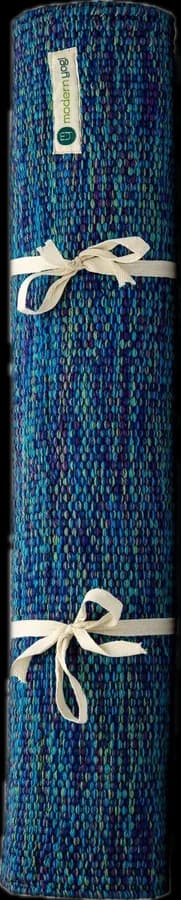
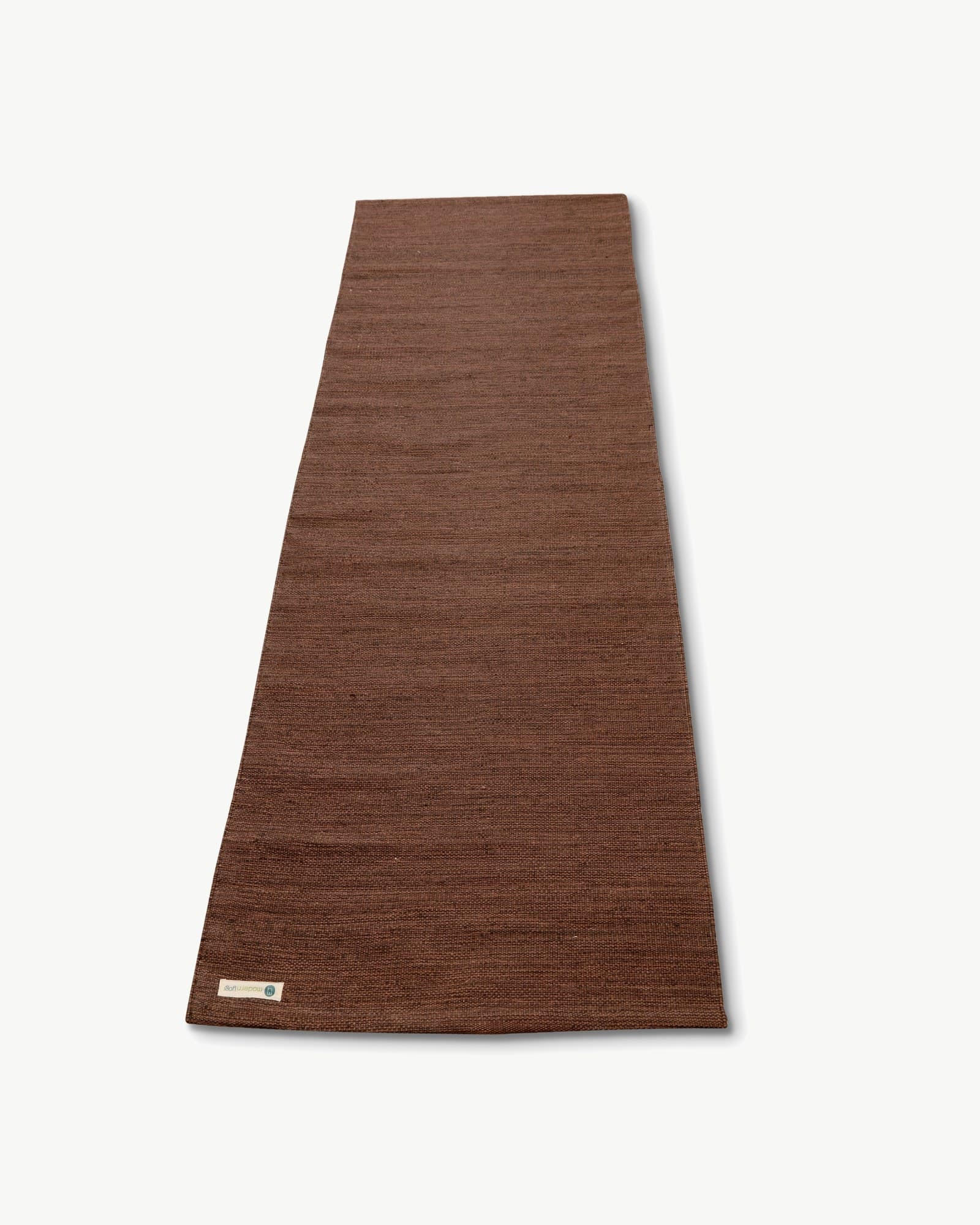
Absorbent surfaces — cotton, and to a lesser degree cork — work the other way. Slightly less bite when bone dry, and they hold their grip as the practice heats up because the moisture goes into the material instead of sitting on it.
So: if your practice makes you sweat, or the room is warm, choose absorbent. If you practise slowly in a cool room, either works, and a rubber mat will feel grippier in the first ten minutes.
Ignore any claim about grip that does not say whether it means wet or dry. It is the only distinction that matters and it is the one marketing avoids.
3. How thick?
Thickness is a trade, not an upgrade. Padding protects the joints that press into the floor. It also destabilises the joints balancing on top of it — a soft surface compresses unevenly under a standing foot and swallows the small corrections balance is made of.
- 3–4 mm. Stable, light, packs small. Best for standing-heavy practice, balance work, travel, and anyone on carpet. Put a folded blanket under your knees when you need it.
- 6–8 mm. Comfortable for kneeling, seated and floor work, and for anyone whose knees or hips complain. Costs you a little stability and about two kilograms.
- Above 10 mm. This is an exercise mat, not a yoga mat. Balance becomes genuinely difficult.
If you cannot decide: most people beginning at home, on a hard floor, are better served by the thicker one, because the early weeks involve a lot of kneeling and the wobble is not yet the limiting factor.
4. What size?
Almost nobody checks this and a surprising number of people are practising on a mat that is too small for them.
The default is 61 cm wide by 173–183 cm long. Two tests:
Length. Lie down on the mat as if in Savasana. If your heels or the crown of your head are on the bare floor, you want a longer mat. This matters more than it sounds: on a short mat you will unconsciously shorten every lunge and every step back for years.
Width. Stand with your feet wide, as if for a wide-legged forward fold, and put your hands to the floor. If your hands or feet land off the sides, you want a wider one.
If you are over about 175 cm, or broad through the shoulders, assume you need the larger size and be pleasantly surprised if you do not.
What not to decide on
Weight, unless you carry it. A heavy mat is only a problem if you walk to a studio. At home it is an advantage — it lies flat.
Alignment lines printed on the surface. They are set for an average body and yours is not it. Use the edges of the mat instead; they are straight and they are honest.
Price at the two extremes. Below a certain point you are buying foam that will compress permanently within a year. Above a certain point you are buying branding. The useful range is broad and most of it is fine.
The short version
- Hard floor, sweaty practice, home: absorbent surface, rubber base, 6–8 mm.
- Hard floor, gentle practice, home: any grippy surface, 4–6 mm.
- Carpet: light, thin, washable. No rubber needed.
- Carrying it to a studio: 3–4 mm with a grippy base.
- Already own a studio mat and just want grip: a thin cotton mat laid on top.
Buy once, look after it, and it will outlast several of your other opinions about yoga.