







NotesPractice
How to Build a Home Sequence
A repeatable seven-part structure you can fill differently every day. Written so you never again stand on the mat wondering what comes next.
Contents
The problem with home practice is not motivation. It is standing on the mat at minute four with no idea what comes next, doing three random poses, and stopping.
Here is a seven-part structure. It never changes. What goes inside each part changes every day. Learn the structure once and you never have to plan again.
The structure
- Settle — 2–3 minutes
- Warm the spine — 5 minutes
- Warm the whole body — 5–10 minutes
- The main work — 15–25 minutes
- Counter and unwind — 5–10 minutes
- Down-regulate — 5–10 minutes
- Savasana — 10 minutes
That is roughly an hour. Compress each part proportionally for shorter sessions; the order does not change.
1. Settle
Sit, or lie down. Do nothing for a minute. Then notice the breath without changing it, then let the exhale lengthen slightly.
Why it is there: it marks a boundary. Without it, the first ten minutes of practice are spent with your mind still on whatever you were doing, and you will find you have done four poses without being present for any of them.
Options: seated breath awareness, a few minutes of counting exhales, lying with knees bent, or a very slow cat-cow with the eyes closed.
2. Warm the spine
Move the spine in all four of its directions before anything else asks it to.
Why: flexion, extension, rotation and lateral bend are the whole vocabulary. Visiting each one gently first means nothing is being asked cold.
Options: cat-cow (flexion and extension), thread-the-needle or a supine twist (rotation), a seated or standing side bend (lateral), and Downward Dog to a plank and back.
Two minutes each, unhurried.
3. Warm the whole body
Get warm. Genuinely — you should be breathing harder at the end of this.
Why: warm tissue behaves differently. Everything in part four goes better after this and worse without it.
Options: three to six sun salutations. Or a set of standing poses done briskly, holding for three breaths. Or Downward Dog to lunge and back, repeatedly. Or, on a low-energy day, five minutes of slow standing poses is enough.
4. The main work
This is the part that changes. Pick one focus per session, not four.
Why one: twenty minutes on hips does something. Five minutes each on hips, shoulders, backbends and balance does nothing at all, and this is the most common flaw in self-directed practice.
Rotate through these:
- Standing strength — the Warriors, Triangle, Half Moon, Chair. Five to eight breaths each, both sides.
- Hips — low lunges, the supine figure-four, wide-legged shapes, Baddha Konasana. Two to three minutes each.
- Backbends — Sphinx, Cobra, Locust, supported bridge, Camel. Build up gradually and hold moderately.
- Forward folds and hamstrings — supine strap work, seated folds, wide-legged folds. Long holds.
- Shoulders and upper back — Dolphin, Puppy, strap work, Downward Dog held long, thoracic rotation.
- Balance — Tree, Warrior III, Half Moon, Standing Hand-to-Big-Toe. One minute per side.
- Twists — seated, supine, revolved lunge.
- Inversion work — Dolphin, propped shoulderstand, headstand preparation at a wall.
A reasonable week: standing strength, hips, backbends, hamstrings, shoulders, balance, and one restorative day.
5. Counter and unwind
Undo the main work.
Why: whatever you just did for twenty minutes has left the body asymmetrically loaded, and this is what stops that accumulating.
The rule: counter with the opposite spinal direction, moderately, not extremely.
- After backbends: knees to chest, a gentle twist, a mild forward fold — a minute later, not immediately.
- After forward folds: Sphinx or a supported bridge.
- After twists: a symmetrical shape — child's pose, or lying with the knees drawn in.
- After standing work: seated or supine hip work, and a fold.
6. Down-regulate
Two or three supported shapes, held three to five minutes each, with no muscular effort.
Why: it moves the nervous system out of the working state before Savasana, so Savasana starts from somewhere useful rather than from an elevated heart rate.
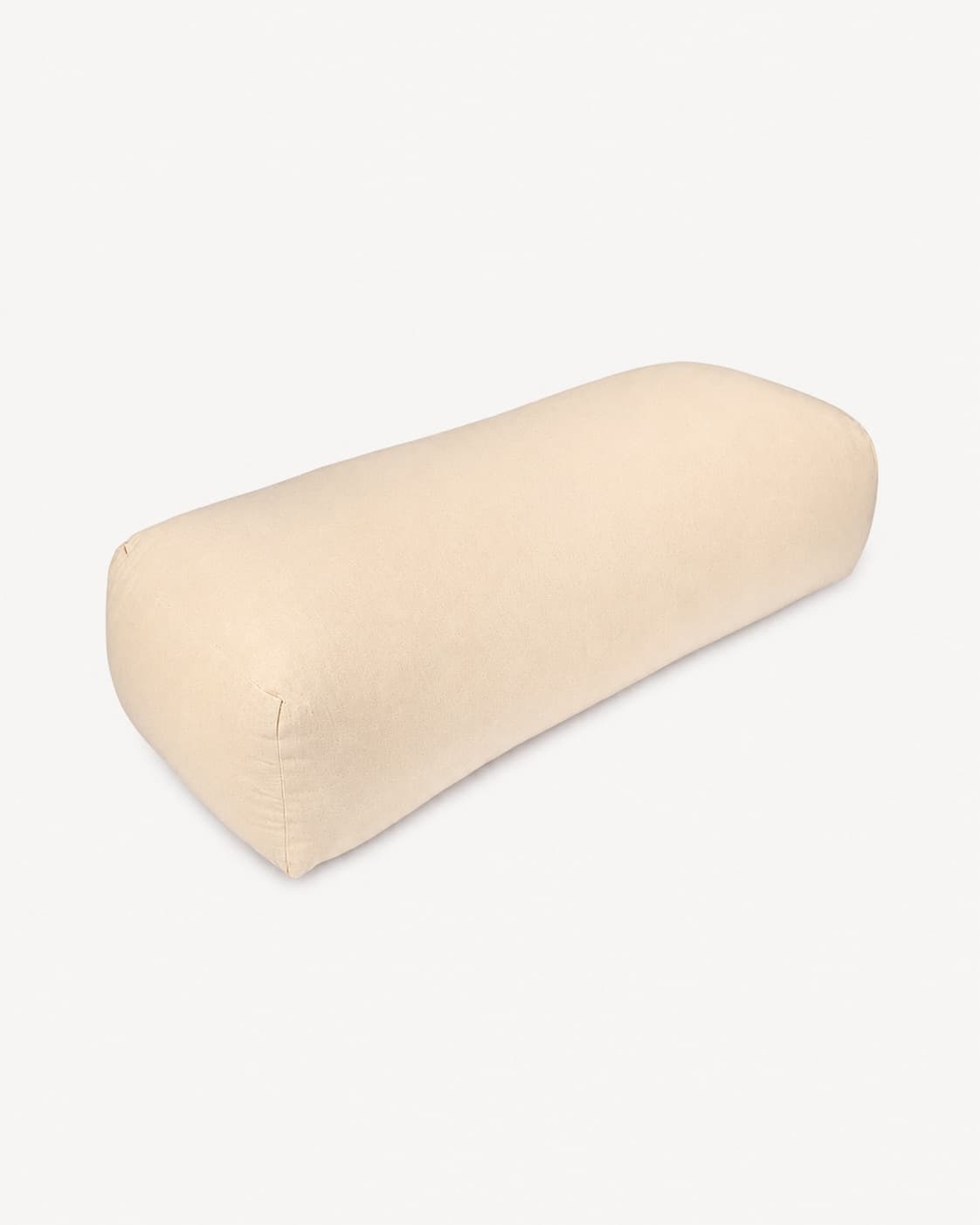
Options: legs up the wall, supported bridge, supported reclining bound angle, a supine twist over a bolster, or child's pose with a bolster under the chest.
Or five minutes of breath work instead. Either works.
7. Savasana
Ten minutes. Propped: blanket under the head, roll under the knees, blanket over the body, something over the eyes.
Non-negotiable. If short of time, cut part four, not this.
Adapting the length
Thirty minutes: settle (2), spine (4), warm (5), main work (10), counter (3), Savasana (6).
Twenty minutes: settle (2), spine (3), warm (3), main work (7), Savasana (5).
Ten minutes: spine (3), one thing you need (4), Savasana (3).
Note what survives in every version: warm the spine, do one thing, lie down. That is the irreducible core.
Writing it down
For the first few months, write the sequence out before you start. On paper, beside the mat.
It removes the decision-making from the middle of the practice, which is where it does the most damage. After three or four months you will have a repertoire in your head and can stop.
The most common mistakes
No warm-up. Straight into the main work, cold.
Four focuses in one session. Nothing gets enough time to do anything.
No counter. Twenty minutes of backbends followed immediately by Savasana, and an aching lower back all evening.
Skipping Savasana. Or doing three minutes of it.
A new sequence every day. You cannot improve at something you never repeat. Keep the same main-work sequence for two or three weeks at a time and you will actually see it change.