


NotesGuides
The Cotton Yoga Mat
What a mat is actually doing under your hands, why cotton grips by a different mechanism than rubber, and how to look after one so it lasts a decade.
Contents
A mat does two jobs. It stops you sliding, and it puts something between your joints and the floor. Almost everything written about mats is about the second job. Almost every bad moment on a mat is a failure of the first.
Think about where a practice actually breaks down. The hands creep forward in Downward Dog (Adho Mukha Svanasana) until the shoulders sit over the fingertips. The front heel skates outward in Warrior II (Virabhadrasana II). You come out of a plank because the palms are travelling, not because the arms are tired. None of that is padding. All of it is friction.
So choose for friction first and treat thickness as the second decision. That order is most of what there is to say about choosing a mat.
Two ways a surface can hold you.
Grip is not one property. There are two different physical mechanisms, and every mat is built around one of them.
Tack. A soft, slightly sticky surface — PVC, TPE, natural rubber — deforms around the ridges of your skin and holds by adhesion. Dry, this works extremely well. It is also, by design, non-porous: the whole point of the material is that it is a sealed, smooth, uninterrupted face.
That is also its failure. Sweat has nowhere to go. It sits on the surface as a film, and a film of water between two smooth faces is a bearing — it separates them and lets them slide. This is why a rubber mat can feel superb at twenty minutes and treacherous at forty, and why the standard remedy is to lay a cotton towel over a mat you bought for its grip. That should tell you something.
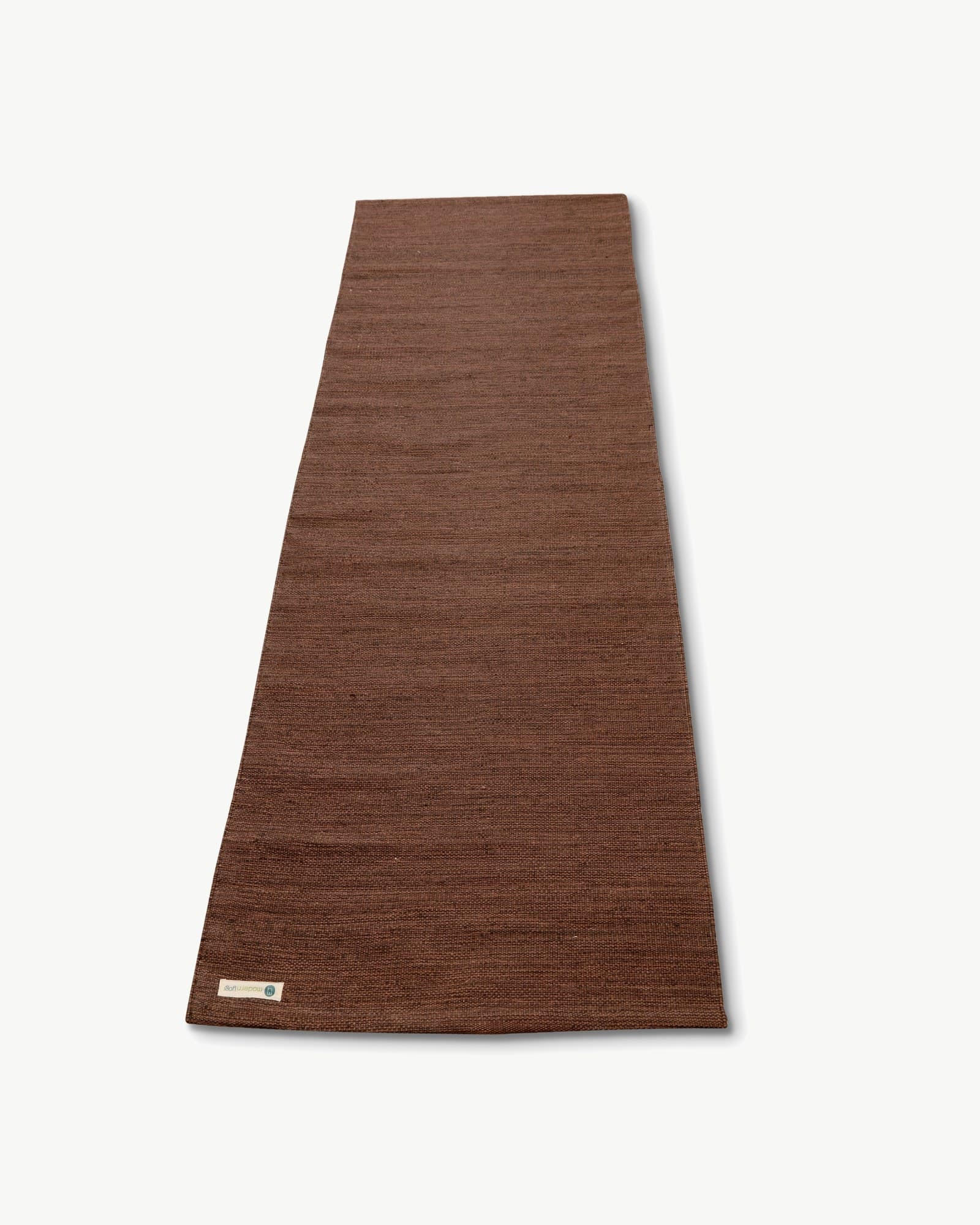
Absorption. A woven cotton surface does not try to be sticky. Dry, it grips mechanically: a weave is thousands of small raised edges, and skin and cloth catch on them. Wet, it does the thing a sealed surface cannot — it takes the water off the contact patch and into the fibre, where it is out of the way. Grip does not collapse when you start to sweat, because the sweat is no longer sitting between you and the mat.
The trade is honest and worth stating plainly. Cold, dry, first thing in the morning, a good rubber mat out-grips cotton. Warm, forty minutes in, it is not close. There is a reason the traditional Mysore room is full of cotton rugs and not sticky mats, and it is not sentiment about tradition.
Two other materials come up. Cork behaves a little like cotton — it gets slightly grippier with moisture — but it is a hard surface and gives you nothing in the way of padding. Jute is textured and durable but coarse enough that most people stop enjoying long holds on it. Neither is a bad choice. Both are surfaces, and a surface is only half the mat.
Read a mat as two layers.
The surface is what your hands and feet touch. The base is what touches your floor. These are separate problems with separate answers, and most mat marketing collapses them into one number.
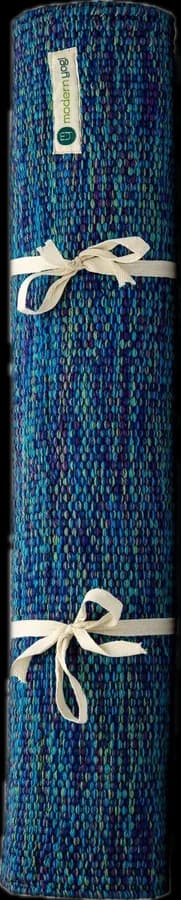
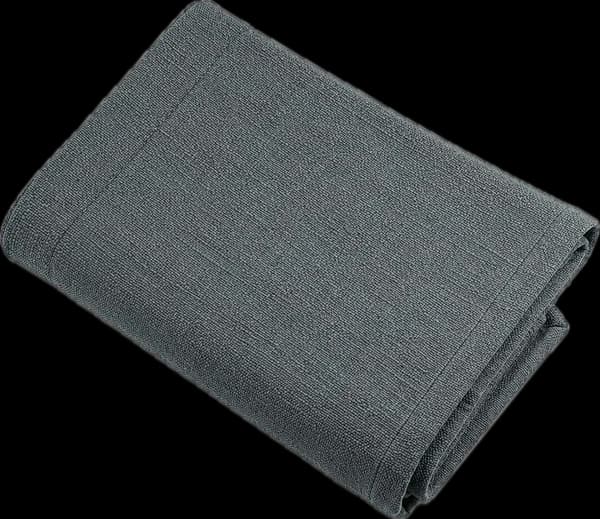
Cotton on both sides. Light, fully washable, reversible, and usable as a topper over a studio mat or in place of a yoga towel. On carpet or a rug it stays put through weight and texture alone. On polished hardwood, tile or marble it will travel — not dramatically, but it will creep across the floor over a standing sequence, and you will spend the practice reeling it back.
Cotton surface, rubber base. The same surface for your hands, plus a rubber underside that anchors on a hard floor. It costs weight, and it costs you the machine wash.
The rule: choose the surface for your hands, choose the base for your floor. If you practise on wood or tile at home, or in a studio on vinyl, take the rubber base. If you practise on carpet, or on top of a studio mat, or you want one washable thing that also travels, take cotton on both sides.
Thickness is a trade, not a level.
Thicker is not more advanced and thinner is not more serious. Thickness protects the joints that press into the floor — kneecaps in a lunge, the outer shin in pigeon, the sitting bones in a long seated practice, the spine in supine twists. And thickness is a tax on the joints that have to balance on top of it. Every millimetre is another millimetre of material compressing unevenly under a standing foot. Tree Pose (Vrksasana) genuinely wobbles more on a thick mat. Standing balance is built out of very small, very fast ankle corrections, and a soft surface swallows the information those corrections are made from.
So pick by the failure you meet more often.
- Knees and shins complain in kneeling and floor work — take the thicker mat, around 6–8 mm.
- You wobble in balance, or your practice is mostly standing — take the thinner one, around 3 mm, and put a folded blanket under the knees when you need it.
The thin mat is also the travel answer: 3 mm rolls to about the size of a bath towel and weighs roughly a kilogram. A 7 mm mat is two to three kilos and takes real space.
One more thing nobody checks before buying: size. The common mat is 61 cm wide and 173–183 cm long, and both numbers are short for a lot of people. Lie down on your current mat in Savasana. If your heels are on the floor past the end, or your hands land on bare floor when you step wide in Prasarita Padottanasana, you have been practising on a mat that is too small for you and quietly adjusting around it for years. 66 × 193 cm solves it for almost everyone.
Living with a cotton mat.
It is cloth. Everything below follows from that one fact.
Cotton on both sides: wash it. Cold machine wash, then lay it flat or hang it to dry. Between washes, a damp cloth over the surface is enough. Wash it when it stops smelling like nothing — for most people, every four to six weeks in regular practice. Each wash softens the weave slightly, which is the direction you want it going.
Rubber-based: do not put it in a machine. Water driven into the weave with a sealed layer on one side cannot dry evenly, and a mat that dries unevenly grows mildew from the inside. Vacuum it, steam it, and spot-clean the surface with a damp cloth. Dry flat.
Never tumble dry, either kind. Heat shrinks cotton and hardens rubber. There is no version of this that ends well.
Dry out of direct sunlight. Ultraviolet light is what ages rubber — it goes chalky, then brittle, then it cracks along the fold lines. Sunlight also pulls colour out of dyed cotton. Shade, flat, and turn it once so both faces dry.
Dry flat rather than over a rail. A wet mat hung over a thin rail dries with a hard crease at the fold that takes weeks to settle out. If hanging is the only option, use something with a wide flat top, and move the fold point each time.
Let it finish drying before you roll it. A damp mat rolled up is the single most common cause of a mat that smells. If yours smells, that is what happened; wash it or air it flat for a day and change the habit.
Roll it, don't fold it. Folds become permanent creases in canvas and stress lines in rubber. Roll with your practice surface facing outward — the outer face of a roll is held under slight tension and lies flatter when you unroll it.
The first month.
A new cotton mat is at its stiffest on the day it arrives, and the ends will curl. This is the weave holding the shape it was rolled and finished in, and it resolves on its own. Speed it up by leaving the mat unrolled under something flat and heavy overnight, or by rolling it the opposite way for a day. Over the first weeks of use the weave relaxes, the surface opens slightly, and the mat settles into the flatness it will keep.
What a mat cannot fix.
If your hands slide forward in Downward Dog on a dry mat with good grip, the mat is not the problem. You are carrying too much weight in the hands. Press down through the base of the index finger and the inner heel of the palm, and send your weight backwards toward the feet until the arms feel like struts rather than legs. The slide stops immediately.
That is the honest limit of equipment. A good mat removes an excuse and gives you clean information about what your body is doing. It will not do the pose for you, and any mat sold on the promise that it will is being sold on the wrong thing.