


NotesGuides
How to Fold a Blanket
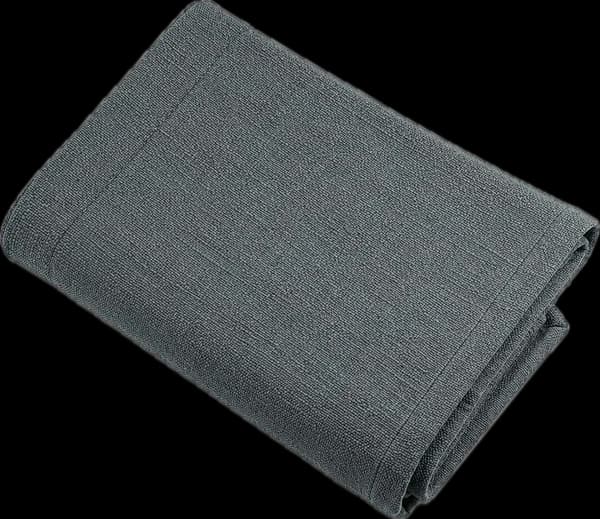
Six folds, each a specific height. This is the difference between a prop that works and a lump of cloth under your knee.
Sommaire
Six folds, each a specific height. This is the difference between a prop that works and a lump of cloth under your knee, and it takes two minutes to learn.
Assume a standard cotton yoga blanket, roughly 200 × 150 cm. Adjust the counts if yours is a different size.
The base fold: how to fold anything neatly
Every fold below starts here, and doing it properly is most of the skill.
1. Lay the blanket out flat.
2. Fold it in half, matching corner to corner. Pull the edges taut and match them exactly. A fold that is out by five centimetres compounds with every subsequent fold, and you end up with a lumpy wedge instead of a rectangle.
3. Smooth the surface with your hand before the next fold. Air and wrinkles trapped inside are what make a folded blanket squash unevenly under weight.
4. Repeat.
The clean edge matters. One side of your folded blanket will have neat closed folds and the other will have loose open edges. Put the closed folded edge where your body goes — under the shoulders in shoulderstand, at the front edge under your sitting bones. It is firmer and it does not slide apart.
Fold 1: quarters — about 4 cm
Fold in half, then in half again. A large rectangle, four layers.
Uses: under the knees in kneeling and lunges. Over the body in Savasana (unfold to use). Under the hips as a very slight lift.
Fold 2: eighths — about 8 cm
Quarters, then in half again. A neat rectangle roughly 50 × 40 cm, eight layers.
Uses: the workhorse. Sitting on for seated practice. Under the head in Savasana if folded down further. Under the shoulders in shoulderstand (you want two or three of these).
This is the fold to learn first.
Fold 3: the head fold — 2 to 5 cm
Fold in half lengthwise, then fold the ends in until you have a long, low, narrow rectangle two to four layers thick.
Uses: under the head in Savasana and every supine pose. It must be low — enough that the chin sits fractionally below the forehead, no more. The most common error is using a thick fold, which pushes the head forward.
Fold 4: the seat — 8 to 15 cm
Eighths, folded once more, or two eighth-folded blankets stacked.
Uses: sitting for meditation or seated practice. Sit on the front edge only, so the thighs slope down off it.
Adjusting height: add or remove a fold, or stack a second blanket. Aim for knees below hip joints.
Fold 5: the roll — 8 to 12 cm diameter
Fold in half lengthwise, then roll tightly from one short end.
Tight matters. A loose roll collapses under weight and is useless.
Uses: under the knees in Savasana. Lengthwise along the spine as a passive chest opener. Under the ankles in kneeling. Under the neck as a cervical support.
Fold 6: the long roll — thin, 5 cm diameter
Fold in half lengthwise twice, then roll from one short end. A thinner, longer cylinder.
Uses: under the ankles when kneeling. Under the lower back in a supine position. Along the spine for a milder version of the chest opener. Around a bolster to add height without changing its shape.
Two-blanket combinations
Shoulderstand. Two or three blankets in eighths, folded to exactly the same size, stacked with the clean folded edges aligned and facing the head. Non-negotiable setup for this pose.
Seated with knee support. One blanket in fold 4 to sit on, plus two smaller folded blankets under the outer thighs.
Supported backbend. A roll along the spine plus a low head fold at the top of it.
Supported child's pose. A bolster or a thick roll for the torso, plus a quartered blanket between the heels and buttocks.
Which blanket
The fold quality depends heavily on the blanket.
Cotton, densely woven, no fringe. Dense cotton folds to a clean firm edge and holds weight without compressing. This is why yoga blankets are what they are.
What does not work: fleece and synthetic throws, which compress to nothing under weight and slide. Loosely woven blankets, which fold soft and lumpy. Anything with a fringe, which is in the way.
Weight: around 1.5 kg for a full-size blanket. Heavier folds better and holds height.
Storing them folded
Keep two blankets folded in eighths, stacked, at the end of your mat.
A blanket in a cupboard is a blanket you will not use. A blanket already folded and beside you is one you will reach for mid-practice, which is the whole point — the prop that gets used is the one within arm's reach.