


NotesGuides
The Mat as a Measuring Tool
Its edges are straight lines and its corners are right angles. Six alignment checks you can run against the mat itself.
Sommaire
- Check one: are your feet actually parallel?
- Check two: is your back foot at the right angle?
- Check three: are your feet on one line, or on a base?
- Check four: is your stance long enough?
- Check five: is your body in one plane?
- Check six: are you square in a symmetrical pose?
- The general method
- What this replaces
- The limit
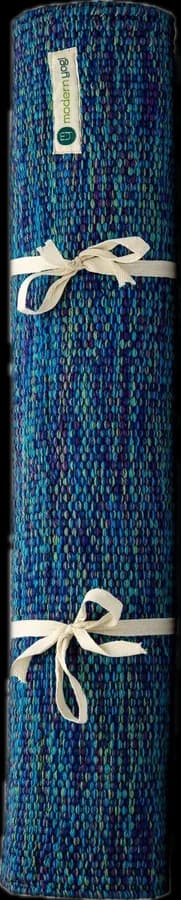
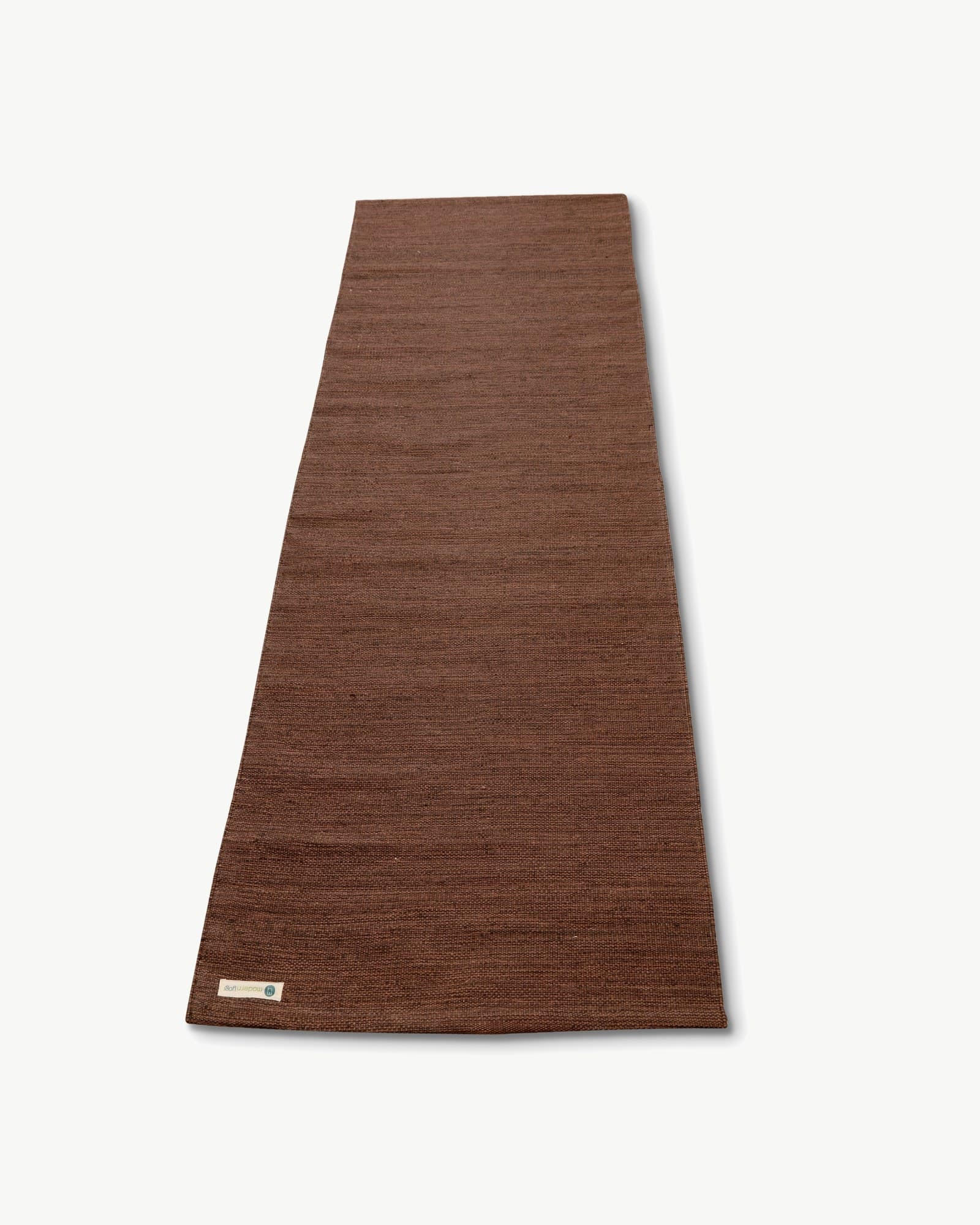
Its edges are straight lines and its corners are right angles. That makes it the most accurate alignment reference available in a home practice, and almost nobody uses it.
Printed alignment markings are set for an average body and yours is not it. The edges are honest.
Check one: are your feet actually parallel?
In Tadasana and every standing pose with parallel feet.
Line up the outer edges of your feet with the long edges of the mat, or with an imagined line parallel to them.
The outer edge, not the inner. Most feet are wider at the front than the back, so lining up the inner edges leaves the toes turned out — which is precisely the position most people already stand in and think is straight.
Almost everyone finds this feels pigeon-toed the first time. That feeling is the measure of how turned out you have been standing.
Check two: is your back foot at the right angle?
In Warrior I and Triangle.
The back foot should be turned in relative to the front. The mat's long edge gives you a reference to judge it against, which a bare floor does not.
For Triangle: back foot roughly parallel to the short edge of the mat, front foot pointing at the short edge.
For Warrior I: back foot turned in to about forty-five degrees relative to the long edge.
Check three: are your feet on one line, or on a base?
In Warrior I, Crescent, and any lunge with the hips squared forward.
Look down at the width between your feet relative to the mat's edges. Most people set up as if on a tightrope — both feet on a single line — which makes squaring the hips nearly impossible.
Step the back foot out towards the mat's edge so there is real width between the feet. Twenty or thirty centimetres. The hip squaring becomes available immediately.
Conversely, in Warrior II and Triangle, the feet should be closer to one line — heel to arch, or heel to heel. The mat lets you tell the difference.
Check four: is your stance long enough?
In Warrior II, Triangle, and Side Angle.
Use the mat's length as a ruler. A well-proportioned Warrior II for an average adult puts the feet somewhere around a metre or a metre and a quarter apart — roughly two-thirds of the mat's width in the wide direction, or a defined fraction of its length if you are set up along it.
The specific number matters less than the consistency: measure where your feet are relative to the mat's edges and corners, and you can reproduce the same stance every time and notice when fatigue has shortened it.
Almost every stance is too short, and this is the check that reveals it.
Check five: is your body in one plane?
In Triangle, Half Moon, and Extended Side Angle.
These poses are meant to be flat — as if between two panes of glass. Almost everyone lets the top shoulder and the top hip rotate forward.
The mat gives you a reference line on the floor. Set up with the outer edge of your back foot against the mat's long edge, so that edge represents the plane you are trying to stay in. Then check: is your front knee tracking in that plane? Is your chest rotating open towards the ceiling, or drifting forward towards the floor?
Better still, use a wall — set the pose up with your back against one and you get continuous feedback. But the mat's edge is a reasonable approximation and it is always there.
Check six: are you square in a symmetrical pose?
In Downward Dog, plank, child's pose, and any seated forward fold.
Use the mat's corners and edges to check that your hands are equidistant from the long edges, that your feet are level with each other, and that you have not drifted diagonally.
Drifting is extremely common in Downward Dog — hands creeping to one side, one foot further back than the other — and it is completely invisible without a reference.
The general method
Set the pose up in relation to the mat, deliberately, rather than just standing on it.
Before you begin: which edge am I referencing? Where should my feet be relative to the corners? Which line am I trying to stay in?
Thirty seconds of setup, and the pose becomes measurable. Without it, you are estimating, and estimates drift.
What this replaces
A mirror. Mirrors show you a reversed, two-dimensional view and encourage watching yourself rather than feeling. The mat's edges give you information without the distraction.
Printed alignment lines. Set to an average, and once you know the six checks above you do not need them.
A teacher, some of the time. A teacher is better, and they are not there every day. The mat is.
The limit
The mat can tell you about position in the horizontal plane. It cannot tell you anything about the position of your spine, your ribs, your shoulder blades, or where the movement in a twist is coming from.
For those, the wall is the better instrument, and a teacher is better still. Use the mat for what it is good at: feet, stance, plane, and symmetry — which is a large share of what goes wrong in standing poses.