


NotesGuides
When to Replace Your Mat
Four tests you can run in a minute. Most mats are thrown away years early, and a few are kept years too long.
Sommaire
Four tests, a minute each. Most mats are thrown away years early and a few are kept years past the point of usefulness.
Test one: the grip test
Wash the mat properly first — soap, then a clean-water pass, then dry it fully. Then, on a dry mat with dry hands, come into Downward Dog and press.
If it grips: the mat was dirty, not worn out. This is the majority of cases.
If it still slides in the hand and foot patches only: the surface is worn through in those places. That is the end of a mat.
If it slides everywhere evenly and always has: it is a material problem, not wear. Different question.
Test two: the compression test
Look at the mat unrolled in good light, from a low angle.
Are there visible depressions where your hands, feet and knees go? Press a thumb into a worn patch and into an unworn edge, and compare.
Even thickness: fine.
Noticeably thinner in the traffic patches: the material has taken a permanent set. This is common in foam and TPE mats after twelve to twenty-four months, and it is not recoverable. A mat that is 3 mm where your hands go and 6 mm at the edges is worse than a uniform 3 mm one, because it is uneven under a standing foot.
Test three: the integrity test
Look for:
- Cracking, particularly along the fold or roll lines. Common in rubber that has been stored in sunlight.
- Flaking or crumbling at the edges. PVC and cheap foam do this as the plasticiser leaves the material.
- Delamination — the top layer separating from the base. Common in cork and PU mats, and it is terminal.
- Tears that have started to run.
- Fibre loss in woven mats, at high-wear points.
Any of these that is advancing: the mat is on its way out. A small edge crack can be lived with for a year; delamination under your hand cannot.
Test four: the smell test
Wash it, dry it completely, and leave it flat for a day. Then smell it.
No smell: fine.
Smells after a full wash and a full dry: the odour is in the material rather than on it, which happens when a mat has been stored damp repeatedly and mildew has established inside the structure. Two more washes; if it persists, it is done.
How long a mat should last
With regular practice — four or five times a week — and reasonable care:
- Cheap foam: 6–18 months. It will compress and flake.
- TPE: 1–3 years. Compresses and polishes smooth.
- PU-topped: 2–4 years. The thin top layer is the limit.
- Good PVC: 5–15 years. The longest-lived synthetic by a distance.
- Natural rubber: 4–10 years, provided it is kept out of sunlight.
- Cork over rubber: 3–8 years. Limited by the bond, not the cork.
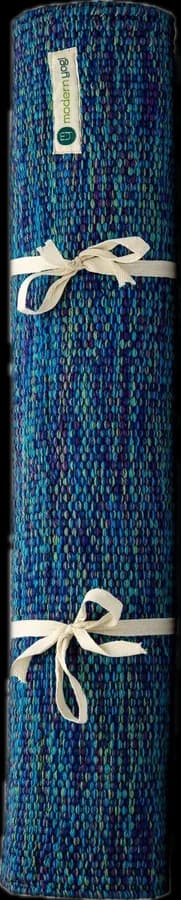
- Woven cotton: 5–15 years. Fails by abrasion, slowly and visibly.
Those numbers assume you clean it and dry it flat. A mat rolled damp after every session and stored in a sunny window will do a fraction of that.
What is not a reason to replace it
It looks worn. Discoloured patches where your hands go are cosmetic. So is fading. So is a cotton mat that has softened and lost its original crispness — that is the mat improving.
It has started to smell. Wash it first. Almost always fixable.
It has stopped gripping. Wash it first. Almost always fixable.
You want a different colour. Fair enough, but be honest about it — and consider keeping the old one as a second layer or a travel mat rather than throwing it out.
A new model came out. Mat technology does not change meaningfully. The materials available now are the materials that were available a decade ago.
When to replace it early
If it is genuinely wrong for you. A mat that is too small, too thin for your knees, or slippery for your practice is costing you every session. Two years of practising badly around the wrong equipment is worse than the price of the right one.
If it is a cheap foam mat and you have decided to keep practising. The starter mat has done its job. This is the upgrade that most improves a practice, and the moment for it is usually around the six-month mark, when you know this is going to continue.
What to do with the old one
Almost none of it is recyclable through household collection.
Rubber, cotton, cork, jute biodegrade eventually, though slowly.
PVC and TPE do not, in any useful timeframe.
Useful second lives: camping mat, under a bike or a washing machine to damp vibration, kneeling pad for gardening, cut into strips as drawer liner or shelf grip, a layer under a plant pot, padding under furniture legs on a hard floor.
A worn mat is often still a perfectly good second layer under a newer one for extra padding in kneeling work, or a mat to leave at a second location so you never have to carry one.
The most environmentally significant decision about a mat is not what it is made of. It is how long you keep it.