


NotesGuides
Ten Things to Do With a Yoga Blanket
The most useful object in the room and the one people understand least. Ten folds, ten placements, and what each one solves.
Sommaire
- 1. Under the sitting bones, for any seated pose
- 2. Under the knees in Savasana
- 3. Under the head, in almost everything supine
- 4. Under the shoulders in shoulderstand
- 5. Under the knee in kneeling and lunges
- 6. Rolled under the ankles in Virasana or kneeling
- 7. Rolled along the spine for a chest opener
- 8. Under the sacrum in a supported bridge
- 9. Over the body in Savasana
- 10. As a strap, a bolster, or anything else
- Two folds worth learning
The most useful object in the room, and the one people understand least. A blanket is not a soft thing to lie under. It is an adjustable-height support that you can fold to any thickness from one to twelve centimetres, which no other prop can do.
Here are ten specific uses. Each one solves a specific problem.
1. Under the sitting bones, for any seated pose
The problem it solves: cross-legged sitting is uncomfortable because the pelvis tips backwards, which rounds the lower back and puts all your weight on your tailbone.
Fold the blanket into a firm rectangle four to eight centimetres high. Sit on the front edge only, so the sitting bones are on the blanket and the thighs slope down off it. Not the middle — the front edge. That downward slope of the thighs is what lets the pelvis tip forward, and it is the entire trick.
If your knees are still above your hips, go higher. There is no maximum.
2. Under the knees in Savasana
The problem: in a fully supine position with straight legs, the lower back is pulled into an arch by the weight and angle of the legs. For anyone with a sensitive lower back this makes ten minutes of stillness impossible.
Roll the blanket and place it under the knees so they bend twenty to thirty degrees. The lower back settles to the floor immediately.
3. Under the head, in almost everything supine
The problem: if your chin is higher than your forehead when you lie down, your neck is in extension and your throat is open in a way that keeps you slightly alert.
A blanket folded flat, two to five centimetres, under the head and the very top of the neck — not the shoulders. The chin should sit very slightly below the forehead. Almost everybody needs this and almost nobody uses it.
4. Under the shoulders in shoulderstand
The most important prop setup in yoga. Covered properly in its own note, but the short version: two or three blankets folded to the same size, stacked, with the shoulders on the stack and the head off it on the floor. This protects the cervical spine from bearing weight at a sharp angle. Do not do shoulderstand without it.
5. Under the knee in kneeling and lunges
The problem: kneecaps on a hard floor.
Folded in quarters, placed under the down knee in any low lunge, in Pigeon, in kneeling backbends, in cat-cow. This is why a thin mat plus a blanket beats a thick mat: you get padding where you need it and stability everywhere else.
6. Rolled under the ankles in Virasana or kneeling
The problem: kneeling with the tops of the feet flat on the floor strains the ankle if you lack that range.
Roll the blanket into a thin cylinder and place it under the front of the ankles, so the feet can flex over it rather than being forced flat.
7. Rolled along the spine for a chest opener
Roll the blanket lengthwise into a firm cylinder about ten centimetres across. Lie on it so it runs along the length of your spine, from the tailbone to the head, with the head supported. Let the arms fall open.
Three to five minutes. This is the cheapest and one of the most effective chest openers available, and it is a good daily counter to desk work.
8. Under the sacrum in a supported bridge
Folded to a firm rectangle, placed under the back of the pelvis in a bridge with the feet on the floor. It gives you a mild supported backbend that can be held for several minutes rather than several breaths. Height determines intensity, and you have all of them available.
9. Over the body in Savasana
Not decoration. Body temperature drops during stillness, and a cooling body will not fully release — it starts to guard. A blanket over the torso and legs for the last ten minutes changes the quality of the pose noticeably. In a cool room it is the difference between resting and enduring.
10. As a strap, a bolster, or anything else
Rolled tight, a blanket is a firm bolster. Twisted, it is a strap that will not cut into the skin. Folded thick, it is a block. It is not as good as any of those things at their own job, but it is present, and the prop you have beats the prop you meant to buy.
Two folds worth learning
Almost all of the above comes from two shapes, and it is worth practising them until they are automatic.
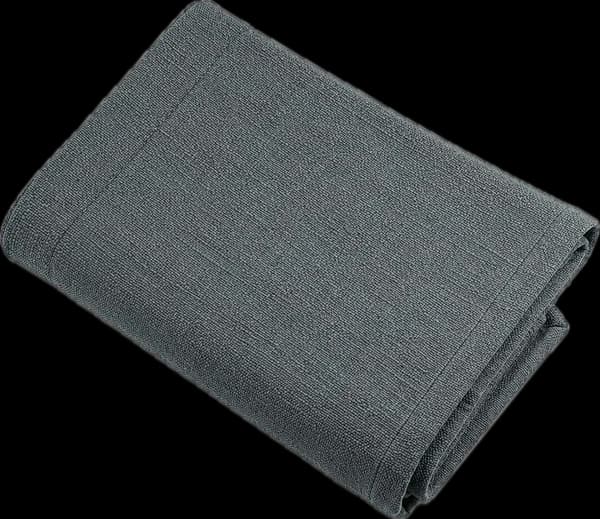
The flat fold. Blanket in half, in half again, in half again — a neat rectangle with clean edges and no lumps. This is the base for sitting, kneeling and head support. Add or remove one fold to change the height.
The roll. Fold in half lengthwise, then roll tightly from one short end. A tight roll holds a shape and supports weight; a loose roll collapses and is useless.
Cotton is what you want for both. It is dense enough to support weight without compressing away, it folds to a clean edge, and it can go in a washing machine — which matters, because the blanket ends up under your face.